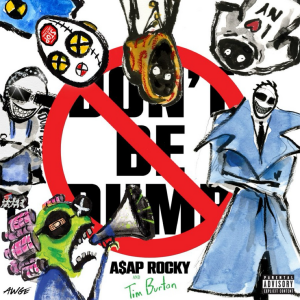
After nearly eight years without releasing any new music, A$AP Rocky at last came out with his fourth studio album titled “Don’t Be Dumb” on Jan. 16. A$AP Rocky, who was once regarded as one of the most stylish and cutting-edge artists in hip-hop, is now faced with the very same question that every long-absent musician eventually has to answer: Has he still got it?
Rocky’s last album, “Testing,” was a split effort among fans and critics. It was acknowledged for its experimental sound; however, it was not commercially successful at all. While some loved it, critics like Pitchfork gave it a low score of only 6.7/10. After that, Rocky was rather actively involved in things like fashion, features and appearance, while music, the foundation of his success, took a backseat.
The album starts off strong with “Helicopter,” the single Rocky released prior to the album’s release, which is the second track on the album. It’s built around busy, high-tempo production that matches the faster, more aggressive sound that has taken over since his departure from music with the popularization of new trap artists. As a comeback statement, it answers the fear that he would return sounding rusty, boldly proving that he still has his voice and rapping ability.
According to the very first statements, as well as the confirmed collaborators. The album is a mix of all possible genres, starting from hip-hop and rock, to R&B, metal and indie. Not to mention that it features the hottest production talents like Pharrell Williams, Mike Dean, Metro Boomin and Clams Casino.
Where Rocky really swings is on tracks like “Don’t Be Dumb” and “Swat Team,” which lean into heavy drums and momentum rather than more of a radio-ready structure. These songs seem designed for something else, and that seems to be the point throughout the album: Rocky isn’t trying to sound polished nearly as much as he wants to sound alive.
If there is a “grown-up Rocky” moment, it definitely shows up the most in tracks like “Air Force (Black Demarco).” Instead of chasing old swagger, he sounds more calculated, almost like he is letting the production do the flexing while he just steers the track. Though it might have worked out fine on this track, that restraint that keeps Rocky holding back too much starts to make other tracks on the album sound more artificial, even though it is the exact opposite of what this album is trying to be. A$AP used to be an up-and-coming artist trying his absolute hardest to fit in with the rest of the industry. But now, he already has everything he wants from the industry. His new sound demonstrates how he wants to make his kind of music, not what everyone else wants from him.
The major concern regarding “Don’t Be Dumb” is not whether the record is good, but whether the wait of eight years was worth it. It’s obvious that Rocky has spent a long time making an album that is rich and textured, but it prioritizes mood and atmosphere rather than hits. This could be disheartening for those who expect mainstream success, but it could be his best work for fans who appreciate artistic risks and long-term albums. While fans of his first few albums feel like this isn’t even the A$AP they know, much of the rest of his fanbase seems to be receiving the album well.
“Don’t Be Dumb” does not attempt to recreate A$AP Rocky’s past, and this might be its most clever move. Instead of playing it safe, the artist challenges the very idea of being relevant. Is A$AP Rocky washed? No, but he is also not trying to be the same artist as he was before. “Don’t be Dumb” is more about proving that he has more endurance on the scene than the rest of the industry. Whether that will connect well with his listeners is yet to be seen, but one thing is for sure: A$AP Rocky has not lost his voice. He is just speaking in a different way.