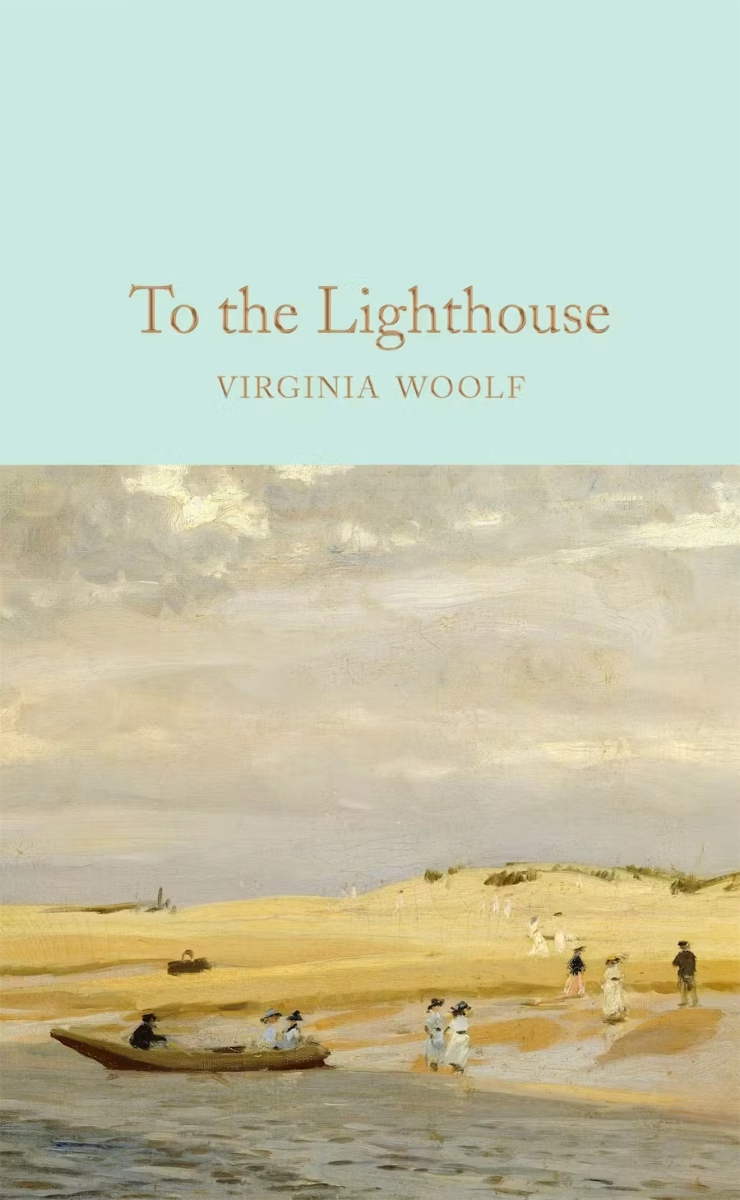
One of the best things a book can do, in my opinion, is really immerse you in its world and its characters. “To the Lighthouse” is a novel by Virginia Woolf, a popular modernist piece that follows the Ramsay family’s trips to their coastal vacation home. While the book has no real central character, instead switching perspectives between the family’s members as well as their friends who have come to stay with them, it did deliver on immersing me into its characters and their backgrounds.
The book is split into three parts, with parts one and three talking about the family’s trips to the coast with Woolf’s standard prose, switching between character viewpoints and really getting into their heads. The second part, however, switches up completely, taking an entirely objective approach to the plot by portraying the passage of time through the way it affects the Ramsay family’s house on the coast. The almost apathetic way she writes this section is very effective at emphasizing how time is unaffected by people or place, and gives the reader a break from the very dense nature of the other two sections.
Still, it certainly isn’t one of the more plot-heavy books I’ve read. The novel focuses on the day-to-day lives of its protagonists, but there aren’t any big events that drive the story along. Woolf’s focus for most of the novel is on characters and their relationships, which she knocks out of the park. I really loved how much time was spent with each character, getting to understand them and their relationships to one another.
Not one character was flat or undeveloped. Even those who behave in an unlikable way or aren’t viewed positively by other characters are given justifications for their actions or behavior. It forced me to empathize with everyone in some way, even if I didn’t like them. Characters like Mr. Ramsay, who is described by other characters as harsh and condescending, are shown to actually be deeply insecure about his status and home life when we finally see his internal monologue. This is just one example of how Woolf is able to balance the external and internal views of her characters, which is the main reason her characters are so strong.
Even the relationships get this kind of nuance, with many characters changing their perspectives on people from time to time. I found this to be very realistic, as nobody is perfectly happy with each other all the time, and no relationship is flawless.
Another thing Woolf does well is her prose. It’s very witty, and I found myself laughing at many moments of the book. She does well balancing the serious nature at many points of the book with sarcasm in the minds of her characters. One of my favorite moments from the beginning of the novel is one of the Ramsay children’s descriptions of their father, when out of the blue, he starts talking about the method in which he’d kill him if he could. Additionally, her descriptions are vivid and beautiful, and really capture that essence of being in a coastal town. I was able to really imagine the house, the village and the vibe of the setting. She has a very strong grasp of detail and how much of it to give the reader, leading to some very enriching depictions of places and people throughout the book.
That being said, Woolf’s unique style of writing can be hard to follow, and there’s definitely a learning curve to reading it. There were a lot of moments that seemed a little unnecessary to me or were kind of boring to read. It’s also not the kind of book you can read passively, and you have to really think about the words on the page, which can get pretty tedious to read in long stretches.
The huge ensemble cast that Woolf switches between frequently can also be hard to understand, to the point that at times, it can become difficult to decipher who the speaker is or whose internal monologue you’re experiencing. I initially struggled with figuring out who was part of the Ramsay family, who wasn’t, and how each of the characters knew the Ramsays. It can get confusing, which is another reason the book takes so long to read despite being only a couple of hundred pages.
While “To the Lighthouse” is an extremely thoughtful look at humans and their relationships, and Woolf clearly put a lot of care into each character, their backgrounds and their motivations, I do feel that the lack of plot and character-focused emphasis of the novel caused it to drag on at times. I honestly think that reading this book would be helpful for writers, or anyone looking to improve their skill in writing characters or setting. I would recommend this book to anyone looking for something that focuses on nuanced characters and well-developed relationships, but not if you’re looking for a book with a strong plot or to get you out of a reading slump.