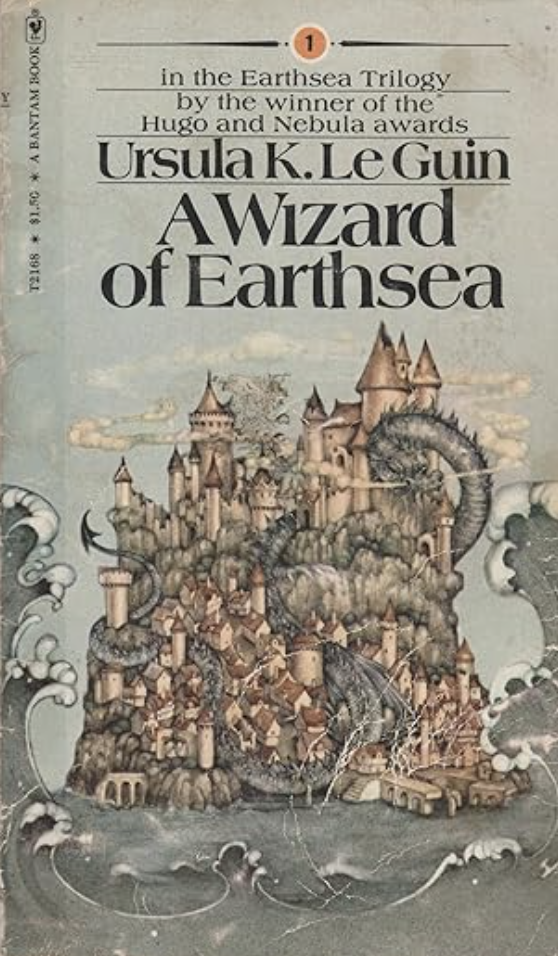
Ursula K. Le Guin’s “A Wizard of Earthsea” is a classic fantasy novel originally published in 1968. Le Guin is also the author of other renowned fantasy books, such as “The Left Hand of Darkness.” “Earthsea” follows Ged, a young boy who leaves his hometown to study the art of magic and become a powerful wizard.
I really liked how immediately we were thrown into the action. I adore fantasy and fiction books that don’t overexplain their worldbuilding through exposition, don’t give any definitions and let the reader kind of figure things out by themselves. With “Earthsea,” a lot of the time, new words or concepts are introduced without an explanation. Le Guin’s writing allows you to figure things out on your own, like what a certain animal might look like or our physical location in the book. This really allowed me to feel like I was diving into the world, rather than being explained to, which I enjoyed.
The highlight of the book for me was definitely worldbuilding. The archipelago of Earthsea is very well developed, and she clearly thought through different nations, their goals and how they interact with one another, making it feel more lived-in. The opening of the book includes an invasion by another nation into Ged’s homeland, and he has to rush to protect it. Just having these kinds of dynamics between areas of Earthsea.
I also adore one of the main concepts Le Guin chose for the book: the entire concept of names holding power. Knowing one’s “true name” is a very special, personal thing, and knowing the “true name” of an object, creature or place gives you power over it. I think this concept, as well as how that plays into magic and the consequences of it, are the most intriguing parts of the book. An example they gave in the book is that different inlets, bays and peninsulas have their own “true names” so that even if one tried to take control of the sea, they wouldn’t be able to control every part. Ged goes by “Sparrowhawk” to everyone except his close friends and family.
I do believe that Ged himself is a very believable teenager in many ways. He is a little whiny at the beginning, a bit sure of himself, and wants to look good in front of his peers. Le Guin does an excellent job describing Ged’s feelings about different situations and allowing him not to be so mature, because he wouldn’t be. He’s a very realistic main character, which I appreciated, and his growth was done very well. It’s refreshing to see a character who isn’t automatically mature just because they have a responsibility given to them. I didn’t realize it at first, but the book is really a coming-of-age story, about finding yourself and growing into adulthood and maturity, which surprised me in a nice way.
I think the thing that threw me off the most about Le Guin’s writing was that it felt very detached. A lot of what was being described didn’t feel like it was from Ged’s perspective, despite focusing on him. It felt more like an omniscient narrator was telling the story, but as a result, we got a lot less personal, which I felt detracted from the story. Additionally, many events seem to happen so quickly that we rarely have time to slow down and focus on any one thing. I felt as though I was being rushed through the story, like I was still in a “montage” section of the book a lot of the time. Because of this detached style, I felt that at times it got a bit boring and slow, even if realistically action was taking place.
Overall, I enjoyed reading “A Wizard of Earthsea,” especially because Le Guin’s work and “Earthsea” in particular are renowned as classics of the fantasy genre. I think an issue that I have with a lot of modern fantasy is that it’s all so similar that any singular book can just get drowned out by a sea of others with a similar premise. “Earthsea” stood out to me because even more than 50 years after its release, it remains unique. Additionally, so many books from that era weren’t very kind to characters of color, or focused mainly on European-based fantasy settings, and so it was very nice to read something with such an explicitly stated diverse cast of characters. It reminded me a lot of the writing style and worldbuilding of Terry Pratchett’s “Discworld series,” which I love, so I’d recommend it to anyone who enjoyed those or is looking for some rich, detailed fantasy that isn’t too heavy to read.