Protests, by definition, are meant to create tension, disrupt and push against systems of authority and the government. They are created to challenge people in power, draw attention to injustice and make leaders uncomfortable enough to pay attention to what you have to say. When protests don’t meet these requirements, they completely lose their value.
Over the past month, students across schools all over the United States participated in walkouts protesting Immigration and Customs Enforcement (ICE) policies, leaving school without excusal and taking to the streets to voice their beliefs. The intention behind the walkout was to show solidarity with immigrant communities and voice opposition against ICE. These walkouts were effective in the sense that they unified the community, showing students that politics is something to care about. However, these protests against authority soon began to resemble school-sanctioned “field trips” rather than disruptions.
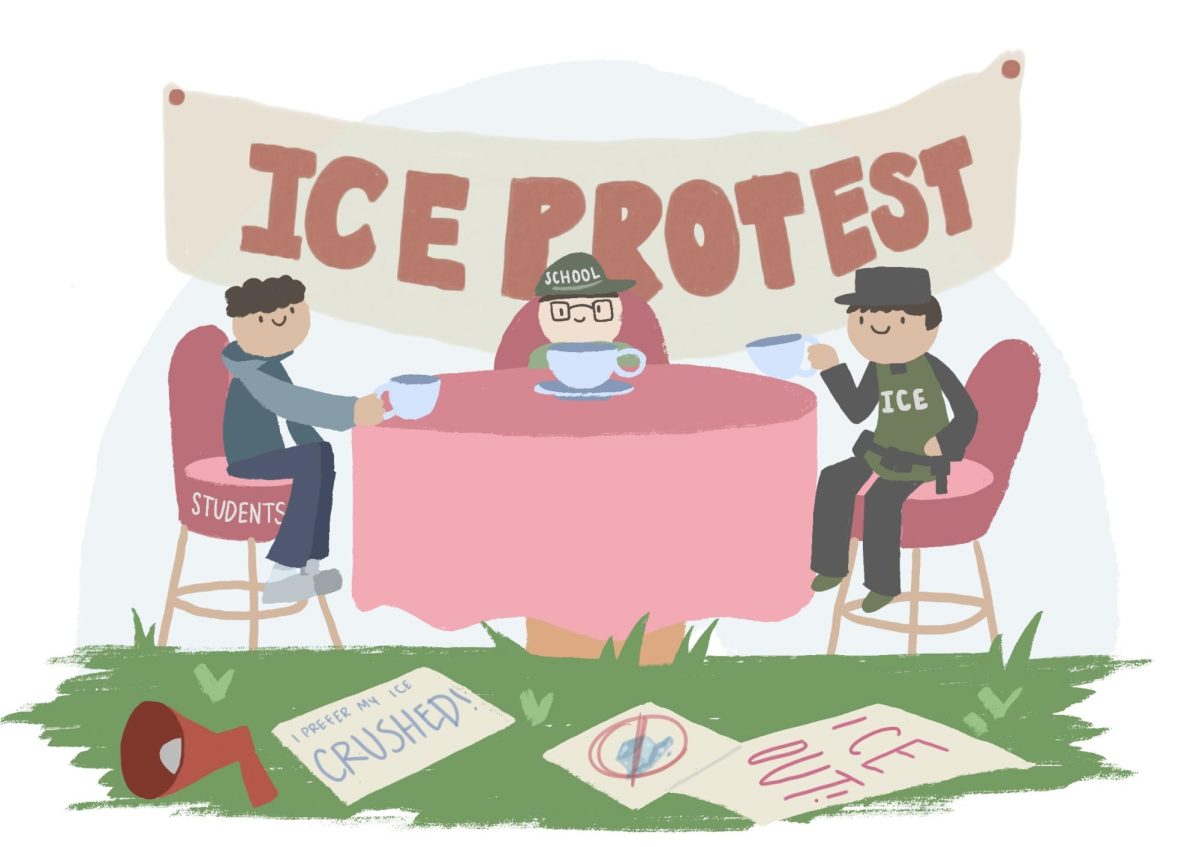
At Dougherty Valley High School, school administrators became heavily involved in the walkout — more than what was expected from them. School staff followed in golf carts and also had the police accompany us. Any safety that their presence had provided was overshadowed by the feeling of supervision, as it resembled parent chaperones guiding a horde of children onto a sidewalk rather than an act of resistance.
The San Ramon Valley Unified School District (SRVUSD) had also sent out an email to both parents and students before the walkout, expressing their support for the students’ actions. This created the feeling of a school-sponsored event, as students were also able to get an excused absence with the reason being “civic engagement,” which grants students one excused absence per year, according to California law (SB 955). When students are given excused absences and are under structured supervision, the protest begins to feel more like a permitted activity rather than a defiant one. The feeling of it being a school-protected event made it feel much less rebellious and the emotional energy that should’ve fueled the protest was diminished.
There’s irony in being excused by the same system that the student body was symbolically trying to protest — if participating in the walkout carried absolutely no risk, it becomes a performative act, especially with more of a handful of students taking this opportunity to split from the crowd, hop into their cars and skip the rest of the school day — and the protest — with no consequence, or head to grab boba at T4 rather than continue on the protest back to school. This doesn’t mean that students should take risks and get punished for speaking out, but it does raise an important question about whether we’re trying to create change or if awareness is enough.
Historically, student activism has been most effective when it causes disruption. For example, the 1968 East Los Angeles student-led walkouts were created by Mexican American students who protested vastly unequal educational conditions. These students left their classrooms without administrative approval, risking suspension to fight for better resources and fair treatment. Because the school district had not sanctioned this uprising, they showed real opposition rather than mere participation, while at DVHS, the school had practically sanctioned the walkout and any risk of suspension or detention that was meant to be present didn’t exist, proving the walkout to not hold any value.
Even climate change activism is effective under the same pattern. Greta Thunberg’s initial school strike in Sweden wasn’t permitted or school-sanctioned; she skipped school on her own to sit outside the parliament, eventually inspiring the Fridays for Future movement, which had spread worldwide. Risk alone does not make a protest effective, but rather, sustained commitment is what matters for change. Though one-day demonstrations can raise awareness, meaningful change occurs under continued pressure and determination. When protests last beyond just a singular event in time, they speak much louder and show people in power that the issue won’t be resolved when the crowd goes home.
In past effective protests, people went against the norms. There was sustained commitment, risk, tension and those who participated had genuine passion about the cause. Historically, student movements that led to change had worked because they stepped outside of permission and comfort. They forced administrators and officials to respond rather than work within their boundaries.
The walkout at DVHS and other high schools demonstrated that students do really care about ongoing political issues, and that holds great value. But, if we want our voices to carry farther than our streets, awareness can’t be the final goal, and a protest shouldn’t simply be an event on the calendar that lasts for two hours before everyone returns to normal life and the issue fades afterwards. I hope the next student protest doesn’t feel comfortable and rocks the boat enough that ignoring all of us isn’t an option.