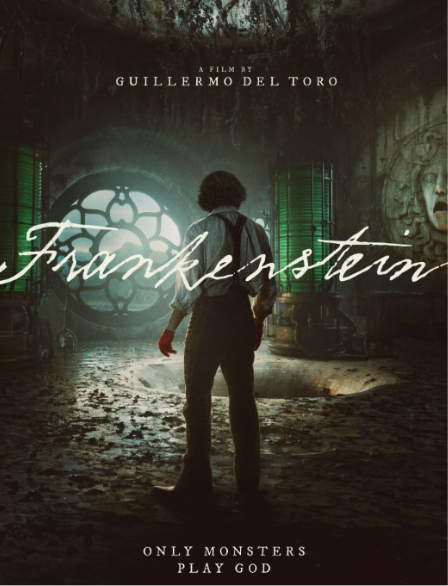
Following its debut on streaming services on Nov. 7, “Frankenstein” (2025) garnered widespread acclaim and hit the ground running with over 30 million views on Netflix — and it’s clear why. The adaptation pleasantly surprises audiences with a fresh plot and thought-provoking messaging that clearly diverges from that of the original 1818 classic. Despite key weaknesses, the new “Frankenstein” holds strong as a heart-wrenching yet hopeful tale.
It’s immediately clear that the film is not just a retelling of the original novel, but a fresh interpretation. Whereas the beginning of the 1818 “Frankenstein” depicts the motivation behind Victor Frankenstein’s scientific pursuits as complexly developed through academia and alchemy, Victor’s backstory in the movie is fairly straightforward: his father tells him that “no one can conquer death” after his mother dies, and a young Victor (played by the incredibly expressive Christian Convery) takes this as a clear challenge. This chain of events carries the subtext of Victor wishing to erase the natural order of women creating life after witnessing his mother die in childbirth.
This new direction sets the stage for feminist themes that are central to this adaptation. Although the original “Frankenstein” is also a feminist novel, the movie makes this message even clearer by explicitly linking Victor’s pursuits to his deep-rooted issues with maternal figures and dismissal of women’s importance — both of which later return to haunt him.
Victor (Oscar Isaac) then embarks upon the task of creating his monster (Jacob Elordi), a journey that is unnecessarily overemphasized in the movie. Far too much of this two-hour film is spent diving into the “science” behind bringing the creature to life, droning about the lymphatic system in a manner reminiscent of an Honors Anatomy and Physiology classroom.
The pacing picks up again after Victor successfully creates his beast, and the clear thematic differences between the book and the movie make themselves known once more. The original “Frankenstein” focuses on the motifs of loneliness, isolation and rejection from society. Yet in this interpretation, the creature is not immediately abandoned by his creator. Instead, Victor chains him up in a basement and subjects him to verbal and physical abuse.
This interpretation comes with both benefits and drawbacks. On one hand, it introduces a novel yet impactful message regarding the cycle of abuse and the long-lasting effects of adverse childhood experiences, as Victor harms the creature in a manner that parallels his own father’s mistreatment of him. However, this portrayal of Victor’s character also turns him from a morally grey protagonist to an explicit villain. While Victor is in no way a perfect person in the original book, this depiction is so on-the-nose that it becomes less compelling.
Victor’s villainous behavior is primarily fueled by his romantic interest, Elizabeth, brutally rejecting him — another divergence from the first “Frankenstein.” While the original Elizabeth is portrayed as an angelic, nurturing woman with no flaws, Mia Goth’s Elizabeth is opinionated, vocal and wants nothing to do with the man that her initial version married. This leaves Victor with no reciprocated romantic storyline, as the movie also cuts out his homoerotic friendship with Henry Clerval. Without a love interest, the focus on Victor’s personal character and flaws was refreshing.
Another notable aspect of the movie’s Elizabeth is her vibrant color scheme. The captivating blues, greens and whites that drape her make her stand out from the rest of the characters in dark apparel. In fact, the color grading and visuals of the entire film were gorgeous. The majority of the scenes were cast in deep blues and greens that captured the aesthetic that popular culture associates with the tragic tale of “Frankenstein.” The color scheme wasn’t the only beautiful visual in the movie. From stunning gothic architecture to devastating flames to mesmerizing underwater shots, there was hardly a single moment in the entire movie that wasn’t visually appealing.
Beyond visuals, another strong highlight of the 2025 adaptation was how brutally heartbreaking the creature’s new storyline was. Instead of being immediately rejected by the entirety of society, the monster is repeatedly shown love and kindness, but inevitably loses it.
Victor is initially caring towards him before eventually becoming abusive. The creature briefly finds friendship and shelter with a wise old man, before being blamed and attacked for his murder. Elizabeth appears to understand the creature on a deep level, only to meet a tragic end. Taunting both the creature and the audience with kindness only to wrench it away, this adaptation’s version of events is far more heart-wrenching than how the events unfolded in the book.
In addition, Jacob Elordi was phenomenal at portraying this heartbreak. He initially faced backlash when his casting as the monster was announced, as it was difficult to imagine a conventionally attractive man in the shoes of a supposedly grotesque character. However, he was unrecognizable in the role, completely immersing himself in the portrayal of a misunderstood, miserable creature.
This depiction of the creature was enthralling right until the end of the movie. In fact, the ending is the weakest component of the entire film. In a wild curveball, the creature decides to forgive Victor on his deathbed, kisses him on the forehead and calls him “father.” Considering how this movie created an extremely negative portrayal of Victor as a monster who tried to burn his creation alive and frame it for murder, this was far too clean an ending. Book Victor was no saint either and was even considered a monster by many, but that’s why his tragic, unforgiving ending made sense for his character. The creature’s sudden change of heart felt akin to a Disney movie and almost promotes something dangerous about forgiving abusers.
This left-field ending was somewhat saved with the final shot of the creature walking into a sunrise after Victor’s death. Despite being previously suicidal, his interaction with Victor motivated him to give life another chance, and a thought-provoking quote appears on the screen: “The heart will break and yet brokenly live on.” It’s an empowering ending that portrays a crucial message about persistence in the face of tragedy.
Overall, in spite of its questionable resolution, the 2025 “Frankenstein” is a beautiful, tear-jerking film that will captivate almost all audiences, regardless of whether they have ever picked up the original. It’s definitely worth watching for both fans of Mary Shelley and Guillermo del Toro alike.