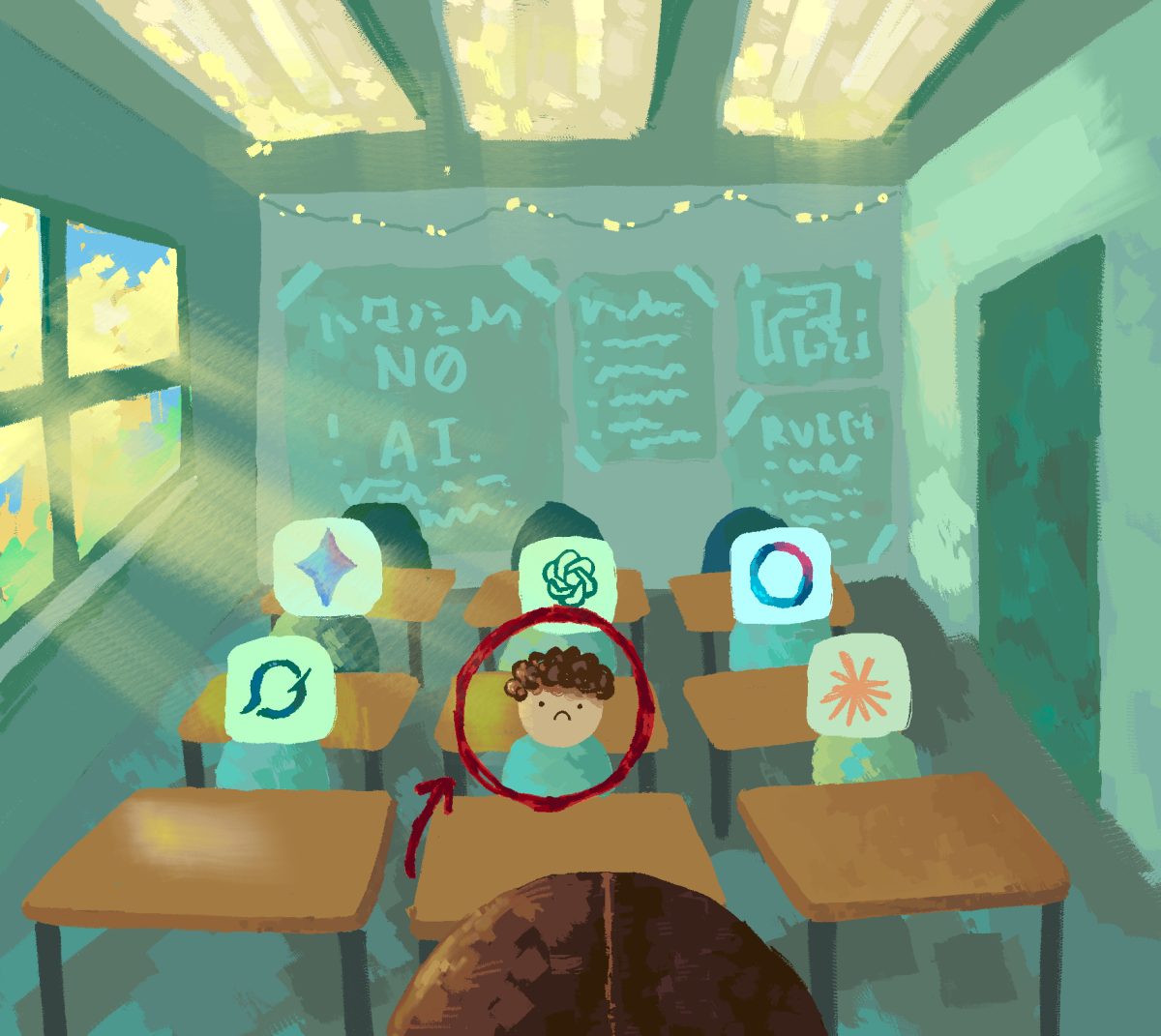
I used AI to write this article.
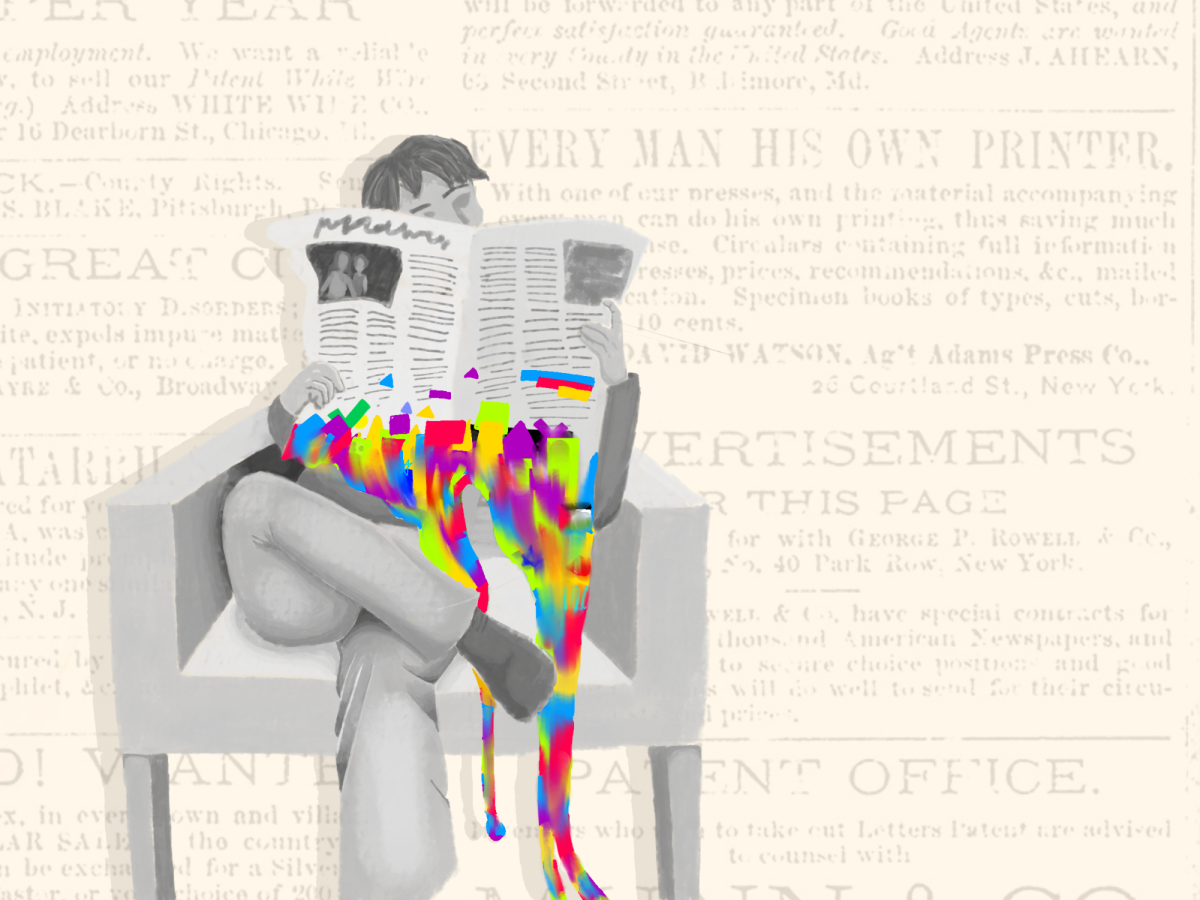
That’s a lie, of course – a hook, as the English teachers would say – but how would you teachers prove me wrong? Would you copy-paste the article into GPTZero and get the 98% human-made, crossing your fingers that this article doesn’t fall in the 2% left over? On the other end of the spectrum, one too many em-dashes and I’m marched up to your desk, given a stern talking-to and stamped with a big fat zero.
Two equally terrible outcomes. ‘But wait,’ you say, ‘isn’t the latter scenario clearly worse than the former?’ The answer is ‘yes,’ but only superficially. Both situations describe only the bare minimum – using an AI detector – and are also reactionary measures that scramble to enforce vague anti-AI rules after the deed has already been done.
This is the true heart of Dougherty’s AI crisis: without proper top-down management on how to deal with and respond to AI, the role of dissuading unethical student use falls entirely on teachers. And you’re not doing enough.
These days, technological innovation moves faster than much of the world, and it’s a given that most will struggle to catch up. However, even in enforcing long-standing anti-AI policies, we’re lagging behind. There’s currently an overreliance on shoddy detection services. So many teachers place all their faith in Turnitin.com, as if the site’s detector hasn’t long since been deemed unreliable by many universities.
The follow-up on enforcement also varies wildly from teacher to teacher, but one thing remains the same: from demanding rewrites until the AI percentage falls below a certain threshold, to directly awarding the student a zero, the default reaction is to blame the student.
It no longer matters what the student has to say for themself, because the easiest course of action is to skip straight to punishment. As long as some of the flagged students actually committed academic misconduct, as long as an example is set, then it doesn’t matter if one or two innocent students are caught in the crossfire, right?
Here’s the thing: students will not stop using AI. Whatever the intentions may be – research compiling, essay planning, slide show making or even outright cheating – generative AI is an incredibly versatile tool that has been all but forced down our throats.
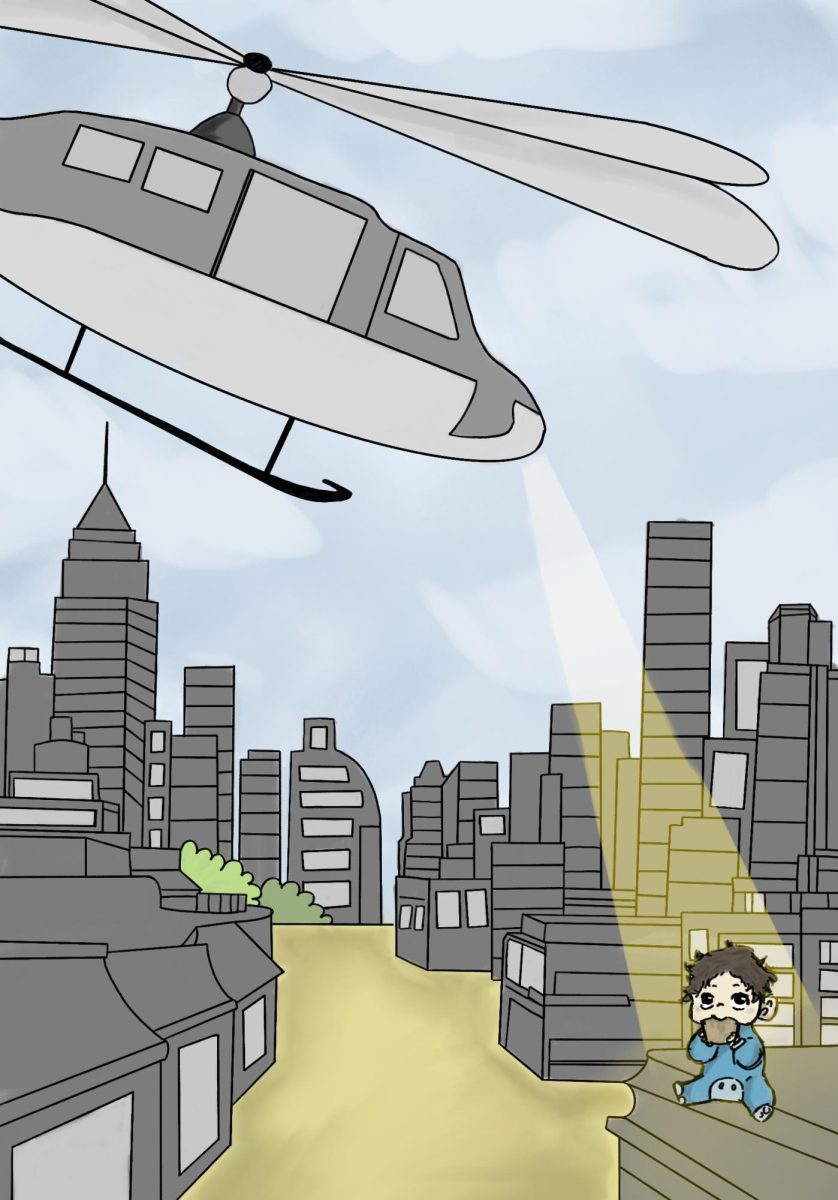
It seems that every day now, another tech giant is embedding their shiny new toy into all corners of the internet. AI ‘agents’ are employed for everything from summarizing Google searches to auto-translating Instagram reels. They’ve been hired to work for us, too – all we have to do is show up to school, log onto our district-provided Chromebooks with our district-provided account and we get access to our district-provided Gemini Pro. Can you really expect students to ignore the path of least resistance when it’s been lined with flowers and paved with stone?
This haphazard management of AI has combined with the blind reliance on detectors to result in the mess we live in now: artificial students taught by teachers who can’t tell the difference. Nuance and personal style lost for conformance to Turnitin.com. A distinct lack of respect underscores each classroom – teachers no longer trust students not to use AI and students no longer trust teachers to believe them when they aren’t.
All the while, looming in the background of this mess of a stage play, the enablers and promoters of this miserable machine: the San Ramon Valley Unified School District.
Since 2024, the district has touted AI integration into classrooms as a necessary step to keep up with the perpetual motion of technological advancement. These plans encourage teachers to use AI to plan lessons, analyze students and provide opportunities to interact with AI as digital assistants, with special emphasis placed in English Language Arts classes. But even though these plans seem comprehensive at first glance, nowhere does it detail any methods for teachers to actually recognize or respond to unethical AI use, with the clearest guidance being to “emphasize the fundamental values that underpin academic integrity.”
The only thing keeping a bunch of 13-plus-year-olds from an effortless A-plus is the click of a button and our word.
Academic dishonesty has always existed, and will continue to exist, especially with all of the “AI humanizers” and “anti-detection tools” and whatnot. There will always be students unwilling to learn. However, this is not an excuse for teachers to continue contributing to a flawed system through their inaction. The students who are trying to learn, who are avoiding generative AI as much as possible, are still often caught in suspicions and accusations.
Breaking free of this slump requires communication and collaboration from everyone – students, teachers and the district. The district must take a proactive stance in addressing unethical AI use, raising a standard – fit with guidelines, examples and instructions to follow in the event that cheating does occur – for teachers to apply in their classrooms.
But we can’t rely on the district for this change. They aren’t the ones in the classroom, working directly with these machines. The regulation of AI starts with us.
The key is to focus on preventative measures, not reactionary. Students use AI because they believe their work, or the effort they’re sinking into it, will not match up to the teacher’s expectations. It falls on the instructors to convince their students that their standards are achievable even without a digital crutch. If students are using AI to complete assignments, then teachers have failed to convince them that the work is worth doing.
However, it’s impossible for instructors to change their entire teaching style just to combat AI, especially this early into the crisis, when it’s still unclear what works and what doesn’t. Despite not striking the core of the issue, there are refined methods for AI deterrence and detection.
Rather than just using Turnitin.com (which really shouldn’t be trusted at all), if a student’s work is flagged for AI, run it through multiple AI detectors. If all of them are flagging, then you can consider a talk with the student. Another option is to search the multitude of Google extensions on the Chrome Web Store for the tools other educators have used and found success in. There are extensions to see where a student may have pasted in text or even track the student’s entire writing process. AI use in academic misconduct is not isolated to our district – other people have met the same problem and found working solutions.
Along the line of prevention, assigning a student to prompt and grade an AI-written essay can show firsthand just how bad their digital minds are at following directions, such as using specific sources. For an idea that is a little more technical, one instance of a handwritten essay can be scanned and used as a baseline for an individual student’s writing style throughout the rest of the semester. If nothing else, AI is unmatched in recognizing patterns – cross-referencing the style of the handwritten copy with future digital submissions is an easy task for a machine, and can be used to double-check after the initial AI detectors flag a student. This would give much more nuance to the detection system, as it compares the student’s writing to itself rather than looking for signs of AI.
But more than AI detectors and intricate plans, more than anything, teachers need to recognize that students are human, too. Before accusing a student of AI use, consider how they would react if that suspicion were false. As a student, being faced with such accusations can be incredibly discouraging, especially when confronted by a person with a teacher’s authority and influence. A wrongful accusation won’t just destroy a student’s grade, but can also impact their motivation to achieve anything more than the bare minimum – if it’s just going to be marked as AI, why put in any effort?
This is why human teachers are irreplaceable: they are able to give the nuance needed to consider the human side of students – personality, habits and writing style – rather than just their work. The role of an instructor is to inspire interest, an interest to learn and interact with the course material, not only to catch and punish academic misconduct after it has already been done.
Human teachers inspire human students. The worst thing a teacher can do is treat their students as if they are a lost cause, doomed with just one transgression. We’re all human here, aren’t we? So please treat me as one.