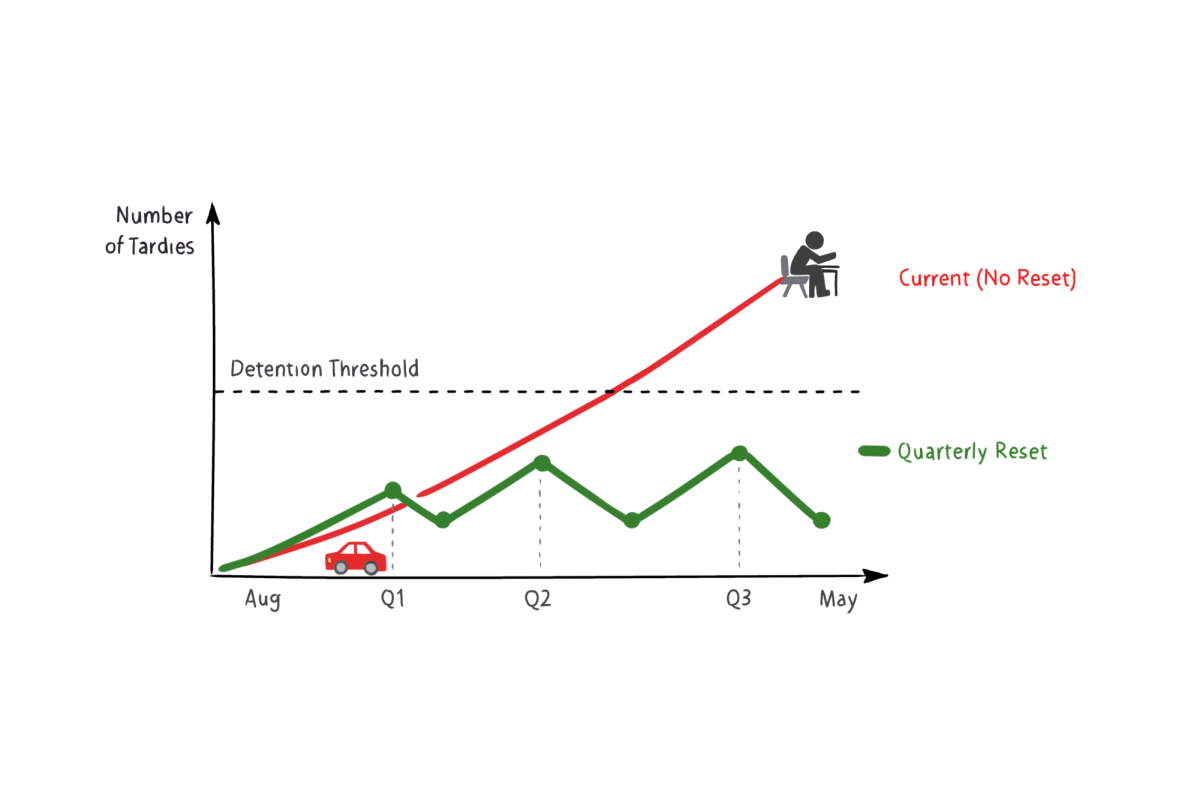
Dougherty’s existing tardy policy is stricter than it needs to be, and it’s not as effective as it’s supposed to be. Currently, students get detention after 10 tardies for the entire school year — that’s 180 days with six periods in each day. If you’re late 10 times out of 1008 periods, you’re only late 0.009% of the time, which would land you a detention. The main issue is that tardies don’t reset anymore; every time you’re late, it keeps adding up from August all the way to May.
I understand why the policy exists, as being on time is important. It makes sense for the school to expect that tardiness can disrupt class, and there should be consequences for it. However, the way this policy works doesn’t match how tardiness actually happens.
Over the course of a full school year, getting 10 tardies is incredibly easy, even if you’re not constantly late. There are numerous days that students are late because of the school’s horrible traffic, especially on Wednesdays, when the combination of that odd timing and everyone going to school at the same time makes for particularly worse traffic.
The old system made far more sense. When tardies reset each quarter, it still held students accountable, but it also gave them a chance to improve. If you were a few days late, you weren’t stuck with that for the rest of the year. You were able to learn from your mistakes and leave earlier to prevent being tardy. Now, once tardies begin adding up, it’s almost impossible to recover from them. Even though detentions don’t go on your transcript, they go on your behavioural transcript, which, although rarely so, colleges can request. Tardy detention usually is not significant and largely does not affect college chances; many parents do not know that. Including this context in emails to parents would help reduce unnecessary stress for both students and families.
If the goal of the policy was to improve punctuality, it should be designed in a way that actually helps students do that. Bringing back quarterly resets, or at least adjusting the policy, would make it more reasonable. It would still encourage students to be on time, but it wouldn’t punish small occasional tardies as heavily.
If they wanted to make tardies cumulative, then the minimum number of tardies needed to reach detention would need to increase.
The sheer amount of detentions being issued is enough to show that this policy is overkill. It feels like a lot more students are getting detention, but there wasn’t any clear communication about changes beyond the tardy policy itself. Because of that, it just comes across as more people getting punished without really understanding why or what changed.
Getting detention over tardiness also feels more serious than the situation actually is. A tardy might be a few seconds or minutes late, but detention carries a much heavier weight. It’s not just about sitting in a room during lunch or after school. It also involves parents being notified, which adds another layer of stress. Explaining to parents why you got detention over something like being a few seconds late can be frustrating, especially when it’s not something that feels significant in the moment, which creates unnecessary tension over something that doesn’t always reflect a bigger issue with responsibility.
It also doesn’t really encourage improvement in a meaningful way. Once you get close to the limit, it feels like you’re just waiting for the consequence rather than actually changing anything. That’s why the reset system worked better. It gave people a chance to adjust and do better instead of just watching the number go up.
Another issue is how strict some classes are about timing. Even being a few seconds late can count as tardy, since many teachers expect students to be in their seats the moment the bell rings. Walking in right as the bell rings is treated the same as being several minutes late, even though these situations are very different. That’s why this policy feels too harsh. Tardies keep accumulating throughout the year without any reset, so small, occasional delays end up carrying the same consequences as repeated lateness. Students should have the chance to redeem themselves before facing severe penalties, because accountability doesn’t have to mean punishing every minor slip.
A more balanced system, whether that’s bringing back quarterly resets or adjusting the threshold for detention, would still hold students accountable while being more realistic about how tardiness actually happens. The current rules are unrealistic, unfair and frankly absurd. A system that unfairly penalizes students needs to be fixed.