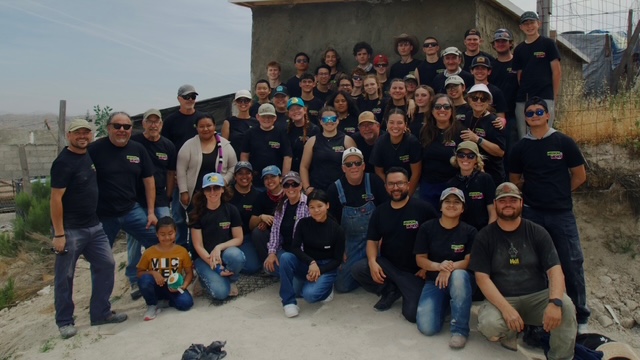
From April 5 to April 11, 2026, several Dougherty students, as well as DVHS’s bookkeeper and campus monitor Fernando Ortiz, traveled to Mexico on a mission to build homes in Tecate, Mexico. They went alongside the youth group at Canyon Creek Church, in partnership with Amor Ministries. This nonprofit organization has been working with pastors in Tijuana and Tecate, Mexico, for almost 30 years to help meet community needs by organizing house-building trips.
Various people across different parts of West America participated in this trip, building 30 homes altogether. The youth group from Canyon Creek Church that included DV students and staff member Ortiz, were able to build 3 homes. For each home, they had to build everything by hand without any electrical tools, including cutting wood as well as separating the rock from gravel. The process began with laying a foundation made from concrete, water and mixed dirt which took around half a day to dry. Afterwards, they built the walls and later the roof, both out of wood. The exterior was covered with chicken wire and paper before a final layer of stucco concrete was added for installation.
Junior Caden Chan, a first-timer on the mission, described how he felt after building the homes, “I had a big sense of accomplishment because I haven’t done anything so large in scale.”
Most who went on this mission mentioned feeling more gratitude for things they had previously taken for granted.
Ortiz described how he’s changed each time he goes on the mission. “Every single time I go, I learn how we forget how much we take for granted, and how grateful [the families there] are for what they have. It really humbles us, and you come back with a different perspective in life again, and it’s nice to be humbled back down,” he said.
Jaiden Liggins, a sophomore who attended the mission during spring break, felt similarly, adding on how she was inspired by the families she met there.
“The people that we met there, they were the most faithful people that I’ve ever met, even though they didn’t have very much, and that was a very inspiring thing to see. After going, I feel very much closer to God and Jesus.”
She continued, “In other ways, it’s also helped me see how much I have compared to others, and how grateful people can be for other things, they didn’t even have paved roads there, so it was pretty crazy to see the difference.”
Similar to Ortiz and Liggins, Chan also described how he felt, mentioning that it was eye-opening.
He said, “It just kind of warmed my heart to see that they had so little compared to what we had, but their faith in God, since we were doing this with the church mission, was really strong, despite the fact that they had close to nothing.”
After building the houses, the group were able to meet the families that they were giving the homes to.
Liggins explained an interaction she had with a family, “[One family we met consisted of] a grandma and a mom and this little boy. They were all so sweet. They only spoke Spanish, so it was a little difficult communicating.”
She added, “One time, I was helping the grandma walk to the house, because the roads are unpaved, so they’re filled with rocks and dust, and I don’t want her to slip because it’s a bit of a hill. I was helping her, and she was telling me in Spanish how she has to walk slowly. But, she was more worried about me than herself when walking, even though she was about to fall. And it just shows how generous these people were.”
To get to the house-building site in Mexico, the group drove from California, splitting among around 10 vehicles. Liggins described, “We left at 3 a.m. in the morning and then we arrived there at around 5 p.m. to 6 p.m. so it was a really long drive, but we also had a lot of breaks. It wasn’t too bad.”
While there, the students and adults had to stay in a campsite which was similar to an open field in the hot weather. They each had to bring their own supplies including tents, sleeping bags and other necessary utilities.
Ortiz described what it was like, “Once we get to camp, we have to set up camp tents. There’s no running water. There’s no showers and you take a little portable shower. There’s a place that provides us with dinner and we have to go to work all day.”
Despite the challenges, Ortiz mentioned that overall the mission was a great experience.
“It’s definitely something where you’ll learn a lot about yourself and learn that you can do a lot more than you realize.”
Chan added on, encouraging others to do something similar in the future as well.
He said, “If you haven’t seen something like that before, it helps you build a new kind of empathy with people who might not be as fortunate. And I think that’s something that everyone should see.”