On Dec. 4, 2016, the sky was a dim shade of gray, overcast and sullen. And it was… quiet. Almost too quiet. A silence reminiscent of the eve of a storm.
And storm it did, barreling into a popular family restaurant in Washington D.C., strapped with a loaded AR-15, a 38-Caliber and a shotgun. On that fateful day, Edgar Maddison Welch, a 28-year-old man from North Carolina, was hellbent on one thing: rescuing the children trafficked by Hillary Clinton and her posse of dastardly democrats.
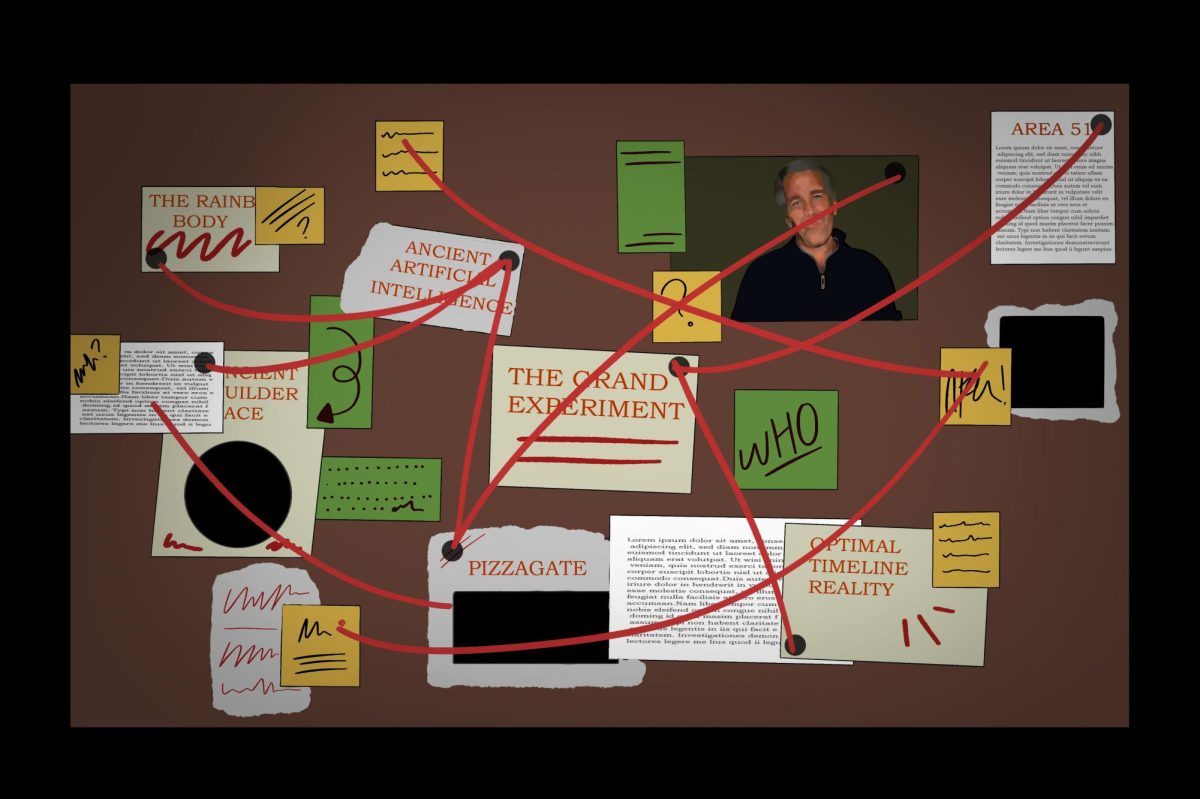
This seemingly outlandish declaration is none other than the infamous proceedings of Pizzagate, the viral online-discourse-branded-revisionist-idiocy that gained heaping traction and visibility during the 2016 presidential election. This far-right, conspiratorial agenda alleged that a Washington, D.C. pizzeria called Comet Ping Pong was the hub of a Democratic-run child sex trafficking ring.
Pizzagate is now often cited as a precursor to QAnon, another notorious prevarication that established the precedent of a global child sex-trafficking ring. This later expanded into the belief that a cabal of Satanic cannibalistic child molesters made of elites, working in coalition with the deep state and operating a global child sex trafficking ring that Donald Trump is secretly leading the fight against (which is pretty absurd considering every accusation Trump has been held accountable for since then).
Naturally, people rolled their eyes at this, calling it nothing but a desperate measure from the alt-right to diminish the Democratic Party. These claims spread like wildfire on various social media platforms before being ridiculed and widely discredited by journalists as well as law enforcement officials. A poll by YouGov published shortly after the Pizzagate shooting states that only 17% of Clinton voters and 46% of Trump voters believed that leaked emails from the Clinton campaign talked about pedophilia and human trafficking.
There’s a term for our rapid dismissal of supposed hoax narratives: cognitive dissonance. In the context of conspiracy theories, cognitive dissonance is the psychological tension that arises when new musings challenge our prior faith in the institutions that we’re taught are built to protect us.
Theories that suggest an inkling of corruption and deceit at the highest level force us to choose between the two rather unpleasant options of believing the world is far more sinister than we’d like to believe or that we’ve been naive, bumbling idiots this entire time.
In seeking refuge from this wildly disconcerting limbo, most people instinctively dismiss ideas that seem too far off the deep end as exactly that. The government has taken great notice of this socio-psychological reflex, condemning those who dare to challenge the status quo as dangerously psychotic, mirroring a subtler version of the loss of constitutional rights.
Framing something as just a conspiracy theory triggers a defense instinct through the ranks, short-circuiting any deeper inquiry and valid scrutiny before it has the chance to take its first breath. Over time, the idea of a conspiracy has garnered a reputation as a sort of taboo and being a conspiracy theorist is a symptom of mental derangement.
While Pizzagate and its offshoots were regarded as laughable by the general public when they were first conceived, its clauses no longer seem so radical. I mean, an underground child/human sex trafficking ring? Run by evil billionaires and politicians who turned out to be real cannibals? Sounds familiar, doesn’t it?
A little similar to the absolutely revolting, detestable revelations brought to light by the Department of Justice’s whack-job issuance of the egregious Epstein files. And just like that, the difference between a bald-faced conspiracy and honest fact was the mere span of a few years.
A core tenet of the Pizzagate argument was that the word pizza was a widely used codeword among the horrendous elites for child-trafficking. Now you must be thinking: these people were definitely on something when coming us with these theories because who on Earth would make the connection from “the unlawful act of transporting or coercing people in order to benefit from their work or service, typically in the form of forced labor or sexual exploitation” according to the Oxford Dictionary’s definition of human trafficking to the beloved staple food of America?
The worst part is that the word pizza is mentioned in the highly redacted, rudimentarily released Epstein files over – wait for it – 890 times. 890 times the word pizza was referenced in the massive 300 gigabyte collection of flight logs, contact lists and court documents, among other flagrant evidence that highly incriminate a repudious sex offender who trafficked young girls to his merry band of billionaire buffoons, paving the way for disgusting pedophiles to come out of the woodwork and into his network of atrocities. But it’s just a coincidence, right? I mean, even with the recent knowledge that these sorry excuses for human beings ate literal babies across several incidents, couldn’t possibly be using the word pizza, especially in the contexts they were used to communicate in code, all the details of their sexual exploitation of minors…right?
Wrong. Dead wrong. Say what you will about conspiracy theories, but it is no chance that this is all a coincidence, not when there are piles — mountains of blatant evidence that very obviously make clear as day how all of these evil, horrific individuals do whatever they please — abusing children, women and men for their own enjoyment, holding us at the behest of their villainous agendas — and the government, while not all but a great amount, is comprised of this network of heinous activity that can be described as none other than downright barbaric. And the worst part? It’s essentially verbatim what people have been raving on about for years, only to be waved away like tinfoil-hat-adorned lunatics.
It’s also extremely crucial to acknowledge that some of the greatest discoveries of all time were built on the foundations of formulating claims that went against the institutions that declared their proclamations reigned supreme. Copernicus’s heliocentric model of the universe, which displaced humans as the center of God’s creation, greatly angered the current authority at the time, the Catholic Church, as it went against a good deal of their preachings, leading him to be labeled as a heretic. Ignaz Semmelweis, who studied two maternity wards: one staffed with midwives and the other with male doctors, to get to the bottom of maternal mortality rates post-childbirth, was sent to and died in an asylum after angering the male doctors with his findings of their utter lack of hygiene being the root cause of women dying while giving birth. Mary Anning, who uncovered an insane amount of fossils including the first complete plesiosaurus skeleton had her massive discovery scorned and labeled fake by the (ahem male) scientific community, deemed a mere fossil collector and not a significant contributor to the world of paleontology, and had her findings branded inconsequential by the father of paleontology himself, George Cuvier, despite her irrevocably unmatched skill in identifying fossils.
We label conspiracies as radical because believing them would push us to confront the reality of our society not being democratic and morally grounded, an ideal we have been indoctrinated to internalize since youth. It’s inherently easier — psychologically safer to chalk something up to madness than to admit our media, our government, our society have conspicuous and suspicious cracks in their structure and a large majority of the crowd are too cowardly to call it out.
For years, our governing bodies have spoon-fed us the notion that complacency and lamb-like obedience were the norm, staying silent was a societal expectation, and that skepticism was asylum-warranting.
This idea reverberates through a multitude of problems that remain unfixed, despite having thousands of studies conducted regarding the matter and stimulating a great deal of debate over potential solutions, never to be enacted. Pizzagate was a litmus test for how quickly we abandon inquiry the moment it threatens the illusion of moral order. The Epstein files shattered part of that illusion, forcing us to confront that the seemingly unfathomable was, in fact, quite true.
We cackle in the faces of conspiracists until their madness turns out to be prophecy. And if that doesn’t terrify us into asking harder questions with even harder answers, then maybe we deserve to live in the bubble of delusion we so desperately cling to.