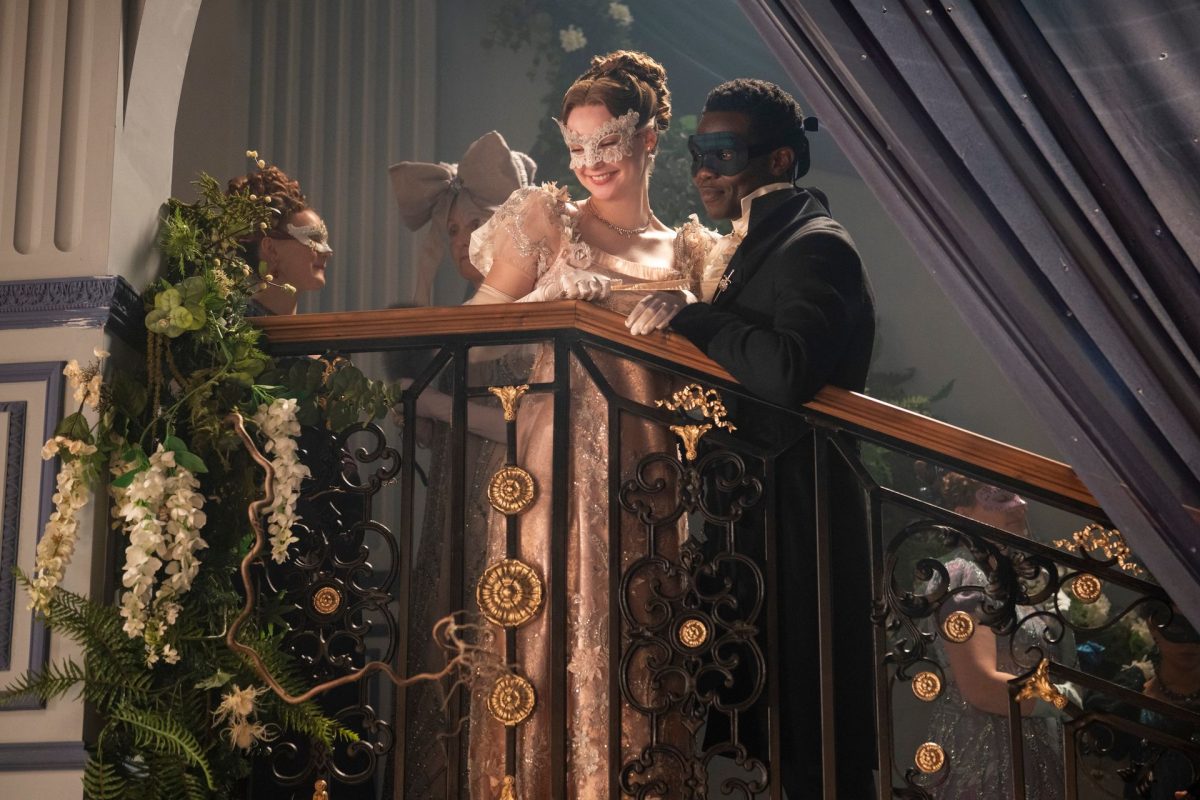
I’ve been an ardent fan of “Bridgerton” since the week I fell violently ill in 2024 and binged the first three seasons in one sitting. I was completely enraptured by the opulence of the candlelit ballrooms, the architecture of aristocratic drawing rooms, the ridiculous grandeur of Queen Charlotte’s hairdos, the cascade of pastel Regency gowns and the racy, breathless romance plots that unfolded behind silk curtains and garden hedges. So I’ll admit that my infatuation with the visual storytelling rendered me blind to its half-baked depictions that allowed viewers to ignore the elephant in the room: insidious undertones of a supposedly racially “equitable” society.
“Bridgerton” has long received backlash for its attempt to diversify high society England, parading Black and brown bodies in a historically white community without depth or reckoning. But in chasing a wide array of skintones, “Bridgerton” does the opposite of what it intended, and instead it caters to the elite liberals’ most cherished fantasy: the idea of neoliberal multiculturalism, where diversity becomes a decorative floral fondant or garnish atop an unchanged hierarchy that’s still rooted in both plunder and exploitation.
In Julia Quinn’s original book series, most of her characters were white, in true fashion with 2000s romance literature. Contrastingly, the show slots people of color into roles that are too brittle and surface-level to fully acknowledge the intrinsic complexities of their inherited ancestral identity. To the “Bridgerton” eye, their society is the epitome of perfection – gleaming, beautiful and moral. People of color hold positions of high esteem and are, most importantly, deemed worthy by one of the most affluent white families in the Ton.
In an interview with Hollywood Reporter, Chris Van Dusen, the creator and executive producer of “Bridgerton,” stated, “… the color of your skin would not determine whether you were high-born or low-born. It meant lords and ladies, dowagers and dukes, of all different colors and backgrounds, could exist in this world. This would not be a color-blind world.” Well, I don’t know if Van Dusen and I watched the same “Bridgerton,” because this revisionist fantasy is nothing if not a perpetuator of aggressive, deliberate racelessness. The world of “Bridgerton” erases the very inequities its color-conscious casting choices claim to transcend, while power and history stay unrelentingly, ruthlessly white. Meanwhile, people of color are left as aesthetic choices, one-dimensional in terms of their culture, and reduced to nothing but objects of desire.
This is exemplified by the dowager Lady Danbury’s most audacious line: “We were two separate societies, divided by color until a king fell in love with one of us. Love, Your Grace, conquers all.” This quote may seem romantic, but it captures the very essence of “Bridgerton”’s agenda of white assimilation. It positions interracial romance as the single most equalizing factor, omitting any mention of structural violence entirely, and it insinuates that racial issues were solved merely because the king married a Black queen, appointing love as the sole engine of racial progress. Missing are discussions about the transatlantic slave trade, the robbery of natural resources that crippled the economic prowess of entire nations and fortunes dripping with the blood of the exploited.
This wouldn’t be as much of an issue if “Bridgerton” fundamentally lacked a colonial history from the start. What induces such an uproar on this problematic framing is the fact that in this “utopian” society, racism did exist. “Queen Charlotte,” “Bridgerton”’s phenomenal prequel, displays the explicit prejudice Charlotte was constantly subjected to, diminished for her darker skin tone and tight curls. Yet, the conversation about the mistreatment of people of color ends there. Systemic hindrances are then resolved not by dismantling a system that fails to support all civilians, but by Princess Augusta’s “benevolent” decree granting titles to the Ton’s non-white elite. Charlotte rises through the ranks of public opinion by embodying the oppressor’s pinnacle of flawless British poise, her Blackness polished into ornament.
Such is the white man’s agenda, or more brazenly, the white neoliberal’s ultimatum. You’ll cast people of color, but you’ll sever them from the atrocities etched into their flesh and marrow, blatantly stating that the only way for a world that abandons prejudice to exist is through assimilation. Neoliberal multiculturalism demands the ballroom be inhabited by a diverse selection of races and ethnicities, all the while disintegrating their historical weight. White liberals savor this capitalist cosmetic and don’t demand reparations, call for land return or demolish structures.
“Bridgerton” has made it glaringly apparent that it doesn’t care for true liberation. Instead, it snake-charms its characters of color into wearing corsets that act as shackles of anti-reformation, maintaining a bedazzled and colonialist depiction of the status quo.