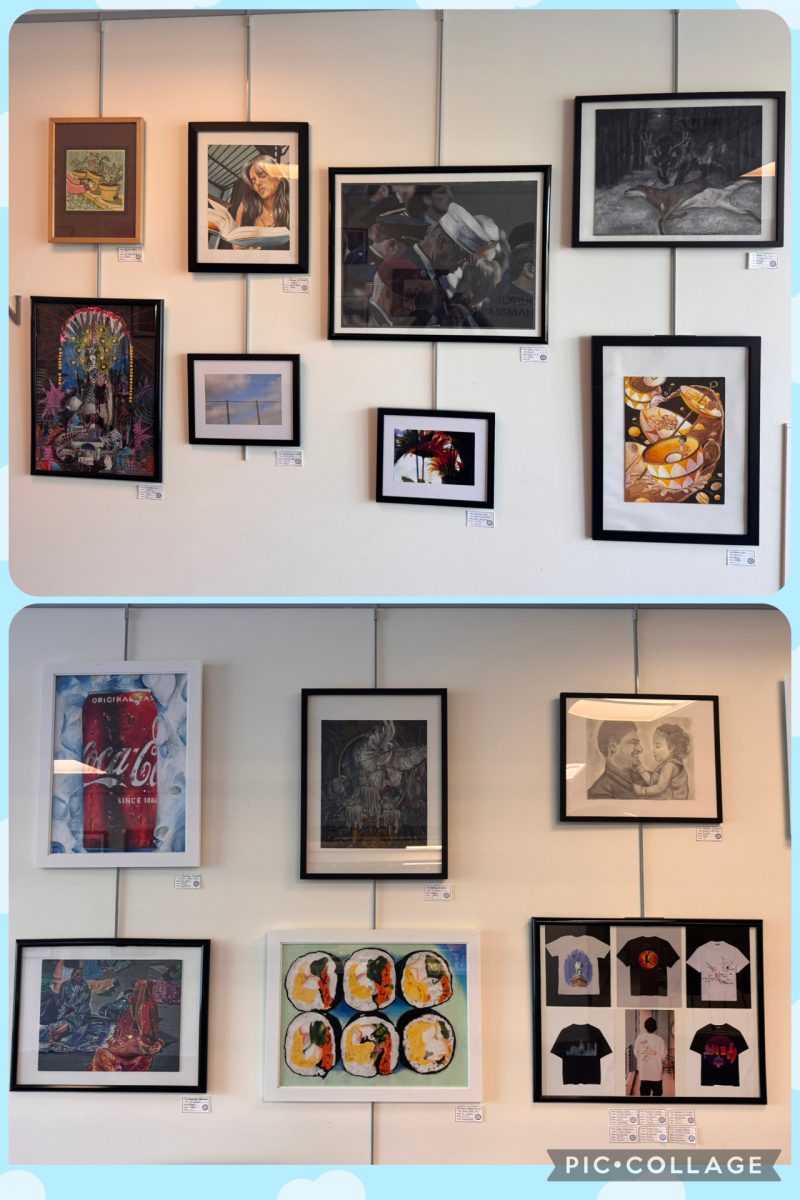
From April 2-29, San Ramon City Hall displayed a collection of student artwork to celebrate SRVUSD high schoolers and their creativity. Each school within the district displays around 20-30 pieces, including ceramics, mixed media and collages. The gallery showcases pieces from DVHS students, using a variety of mediums such as acrylic paint, colored pencils and lino print.
Kelsey Wengel, an AP Studio Art teacher at DVHS, explained the behind-the-scenes work that went into the exhibition for student artists.
“The logistics can be challenging,” Wengel described. “Getting the pieces there, figuring out the frame size, label, and hanging them all up have its challenges. We load everything on April 1 which takes about 3 hours, which can go outside our work time like volunteering.”
Layout takes a lot of consideration, requiring thoughtful planning and ensuring the pieces fit well together with all the other work.
“Curating the pieces, as well as filling the space appropriately are important,” Wengel commented. “We have to decide whether we want an entire wall to showcase a common theme and what pieces should be at the front to greet the audience.”
The pieces in the exhibit portray this with the array of concepts covered. From deep portrayals of suffering and misjudgement to lighter themes such as oversized food and objects within circular shapes, these artwork depicts a range of social and emotional perspectives.
Junior Aditi Ranjan entered a graphite piece titled “Silent Suffering.” The work portrays a young girl having her mouth covered by an outstretched hand behind the subject. The girl’s face conveys fear and pain as tears fall from her eyes.
“I chose graphite because I’m very experienced working with it,” Ranjan explained. “It is quite a versatile medium, which allows me to improve detailing in my artwork and deliver heavier emotions to my viewers easily.”
Ranjan’s inspiration for creating the piece came from wanting to explore how emotions can be made accessible through being conveyed by art.
“The main message of my piece is trying to convey the feeling of fear, and how it can lead to anxiety and suffering which is often overlooked by society,” Ranjan elaborated.
Sophomore Sylvia Mai, who submitted a lino block print piece, portrays a hand picking up a plant with two other potted plants in the background. The piece was created by using multiple linoleum blocks that she carved, inked and then printed onto paper.
Titled “For Your Consideration,” the depiction of choosing between three plotted plants and ultimately choosing the one with the most pink on its leaves, shows how people initially judge others by their outward appearances,” Mai commented.
Mai chose this medium because of a love of planning the most effective and appealing way to use color in each section of her piece. The block print also helped her achieve the graphic style she was going for.
“Over the past few months, I’ve been experimenting with commentary on universal experiences in unconventional ways, and I found out that the subject of plants was a really interesting way of approaching topics like this,” Mai explained.
Sophomore Aashrita Addlapalli, an AP Art student, used one of her pieces labeled as “2 Women” in the exhibition. The piece portrays two women decked in colorful fabric sitting on the ground.
“I’ve been using acrylic since I started painting and I’m really comfortable with the medium. I added collage elements to try to venture out of my comfort zone and hopefully get a more unique and interesting look,” Addlapalli stated.
Creating the piece itself has its own obstacles, from figuring out the message the artist wants to convey to navigating the medium used. However, students still find ways to overcome them.
“A challenge I faced was trying to figure out how to create a good contrast between my background and the main figure in my piece,” Ranjan said. “Since I was using graphite as my primary medium, I needed to be careful how dark my shading would have to be for each portion of my art piece.”
Some students use pieces that they have made prior, especially those in AP Art. In that particular class, deadlines can be tight and provide a challenge of its own.
“We have two weeks to finish a piece and when I made this piece it was at the beginning of the year so I wasn’t really used to the pacing yet,” Addlapalli conveyed.
Art exhibitions help promote art which at times can be ignored and unappreciated while also supporting the students. These events offer students an area to showcase their artistic style to a larger audience.
“The exhibit highlights AP Art students with their portfolio,” Wengel expressed. “By having the pieces there, it is a multifaceted opportunity as well as a resume builder. It helps to promote our art department and shows the viewers value.”
Ranjan echoed similar sentiments about the impact the exhibition has for students, expressing that it highlights all the hard work and talent that they possess.
“It serves as motivation for us and also brings our community together through art,” Ranjan added.
However, running the exhibit comes with challenges for staff and artists alike. An issue that often arises is when students’ work is turned down due to implemented restrictions on the number of pieces.
“We let the students choose what and if they want to enter,” Wengel said. “Sometimes not many people want to participate, but there are times where there are more pieces but only limited spots. I unfortunately would have to turn people away.”
Taking down the pieces is much easier. The frames are saved and re-used throughout the years, once again being hung up during the DVHS Festival of the Arts towards the end of May.
“The art show in DVHS has everyone in it, and helps those who didn’t get chosen for the exhibit,” Wengel stated. “However, it is up for only a night, so it doesn’t have the same impact as being displayed in City Hall.”
Despite the festival being short-lived, having students’ artwork open to the public eye has a more meaningful effect on students alike.
“Having the opportunity always changes the function of students’ crafting,” Wengel mentioned. “Knowing that their piece would be visible gives the students a different perspective. It can change the lens of creation as they create pieces with more meaning rather than aesthetics.”