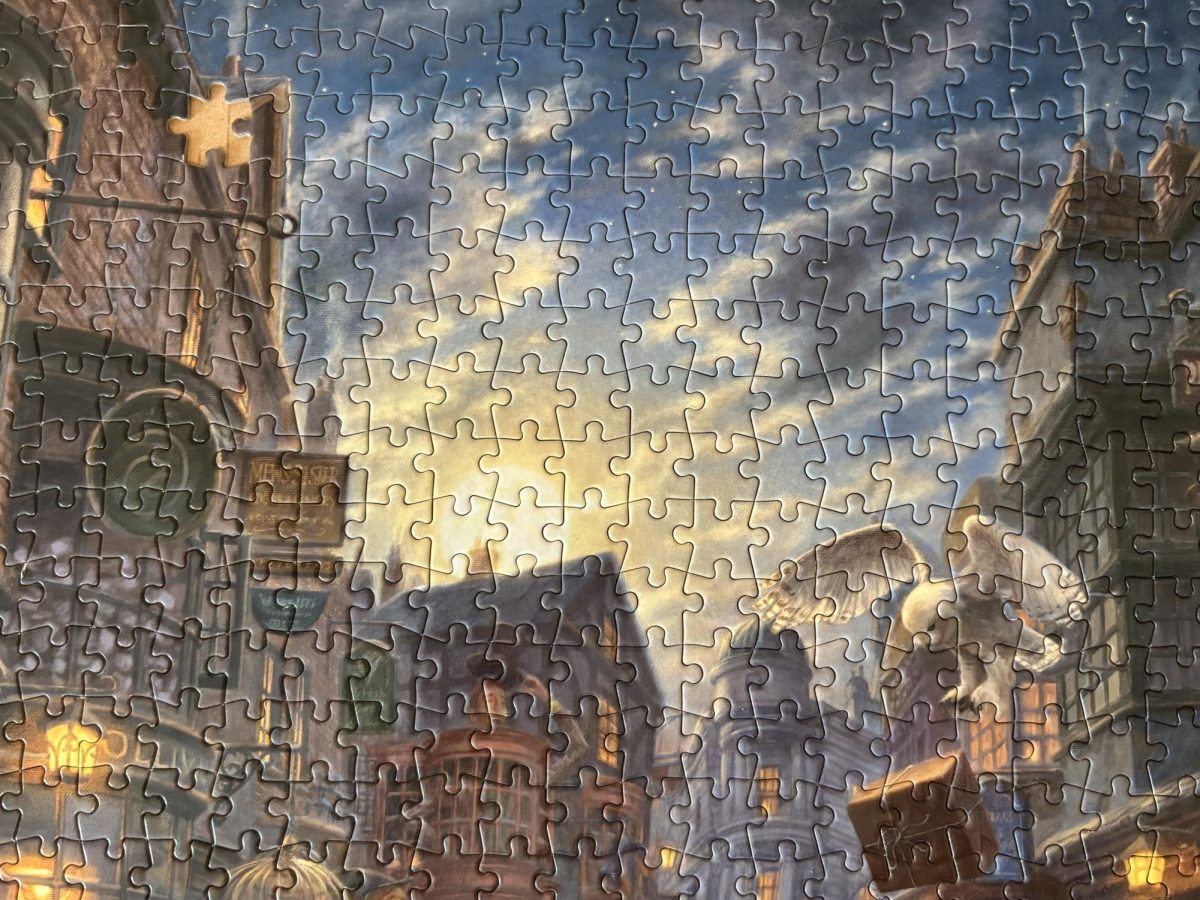
Even though some people may think of puzzles as simply connecting paperboard pieces, they require a unique skill set to fully complete, while also offering several benefits for the mind.
The earliest puzzle dates back to Ancient Greece and was called Archimedes’ Stomachion. In the 1760s, London mapmaker John Spilsbury further advanced the field by inventing handcrafted geographical puzzles called “dissected maps.” However, at this time, only very well-off families could afford puzzles. The jigsaw was invented in 1855, and the name “jigsaw puzzle” finally gained traction in 1906. After cardboard and the modern die-cut method emerged, puzzles became more affordable and readily available for the general public.
According to NPR’s Weekend Edition Sunday, the popularity of jigsaw puzzles significantly increased during the pandemic as families looked for something comforting to do to keep busy. Jigsaw puzzles remain a common recreational activity today, with more than 1.8 billion sold worldwide each year.
Buffalo Games, a well-known American toy company, asserts that puzzling requires focus, attention to detail, patience and strategic thinking. In addition, many avid puzzlers face roadblocks and challenges throughout the puzzle-building process.
Art teacher Kelsey Wengel first got into puzzles after enjoying piecing them together at her grandparents’ house as a young kid.
“Some of the most frustrating things with puzzles are when you’re missing a piece or when you think you can’t find a piece, but it’s actually been sitting there right beneath your nose,” Wengel said.
She gave insight into her creative solution to lost pieces, sharing,“If I’m ever missing a piece, I just usually trace the negative space with a piece of cardboard and recreate it so that we don’t have that empty hole bothering us.”
Library Media Coordinator Annalisa Raphael recalled that engaging in giant floor puzzles in preschool piqued her interest for puzzling.
“Somehow, I always manage to miss a few of the edge pieces. Then, when I go to do the edge, and I’m missing pieces, I have to go back and sort through them,” she commented.
Such obstacles help facilitate a sense of accomplishment and satisfaction when puzzlers finally insert their last pieces. Besides being a beloved pastime, puzzles offer several benefits to physical and emotional health.
According to the National Institute of Health (NIH), puzzling may help prevent chronic stress and aid in the regulation of distressing emotions. In line with this idea, Raphael asserted that puzzling can promote mindfulness.
“I think taking the time to sit down and focus on one activity can help take your mind off other stressors. Giving you something to do with your hands is also helpful,” she said.
Yoga teacher Ann Noel Booras, who incorporated puzzles into her own class after being inspired by videos on Instagram, agreed with Raphael’s perspective. She explained that puzzles are “a great way to focus your attention and all of your energy on something positive rather than sit and ruminate over the things that are stressing you out or bothering you.”
NIH also found that working on puzzles consistently over the long term can improve processing speed, cognitive flexibility, episodic memory, mental rotation and global visuospatial cognition, which is defined by Science Direct as the ability to interpret visual images in order to maneuver an environment. In accordance with this, Wengel stresses that puzzles exercise cognitive skills, expressing, “it’s visually stimulating, and it’s problem solving.”
Furthermore, both Wengel and Raphael highlighted the theme that puzzling promotes positive social interaction.
“I think it’s sort of a low-risk way for people to work together who maybe have not worked together before. I thought it created a nice community with the students this year,” Wengel expressed.
“I’m super happy that just seeing something random on social media has turned into such a positive influence in class. I hope more teachers embrace it. It’s a great way for kids to make connections, de-stress and focus their attention,” Booras said, concluding her thoughts on puzzles.
There’s a hidden world of skill and health advantages behind the classic, unsuspecting jigsaw puzzle that tends to get overlooked. In addition to being entertaining and challenging, puzzles also help combat stress and provide a variety of cognitive benefits, as well as a platform for social interaction.